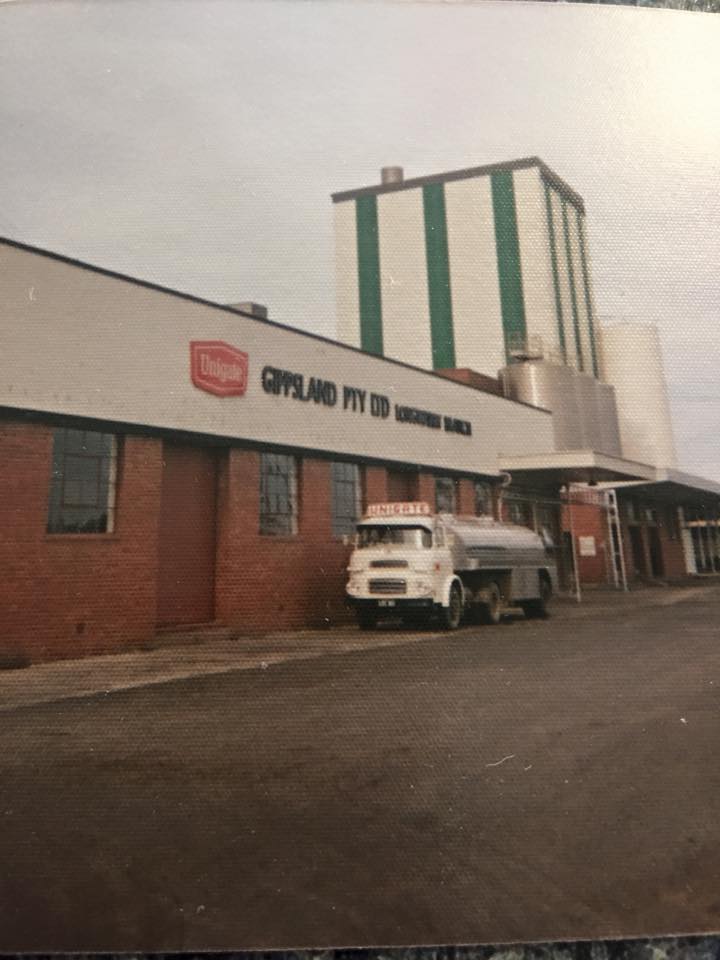
Factory mid 1970’s
The news that after 105 years of dairy production on the same site will end with the closure of the Longwarry factory next year, there will be a lot of sadness and waves of nostalgia for many current and former Longwarry residents.
By the turn of the century on the cleared land that had been leased under the Land acts of the 1870’s there was the beginnings of an early dairy farming community. The arrival of the train line in 1877 played a big part in this growth, as milk buyers from Melbourne travelled around the district, buying milk at the farm gate and then each day, using hand separators, the farmer would place the cream in cans and take it to the station to be transported by train to Melbourne.
This was not very satisfactory for the farmers as not all buyers from Melbourne could be relied on to pay quickly, if at all, and farmers began to think there must be a better system than this ad hoc way of selling their milk, so in 1919 a move to establish a milk depot in Longwarry was canvassed.
By 1921 The Longwarry & District Dairymen’s Cooperative was formed. Farmer suppliers bought shares in the Co-op and a building was constructed to deal with district supplies of milk. The capital required was set at £3000, in 8000 shares of £1 each, payable of 2/6 on application and 2/6 on allotment, the balance to be paid at the rate of 2/6 a share at periods not longer than three months.
When the factory opened 1000 shares had been applied for and Messrs. Boxshall, Bain. Suelf, Crome; Lilley, Walters and Clifford were appointed provisional directors.
Through out the 1920’s the factory prospered and the farmers were very happy that they now had a centralized and organised way to handle the sale of their milk.
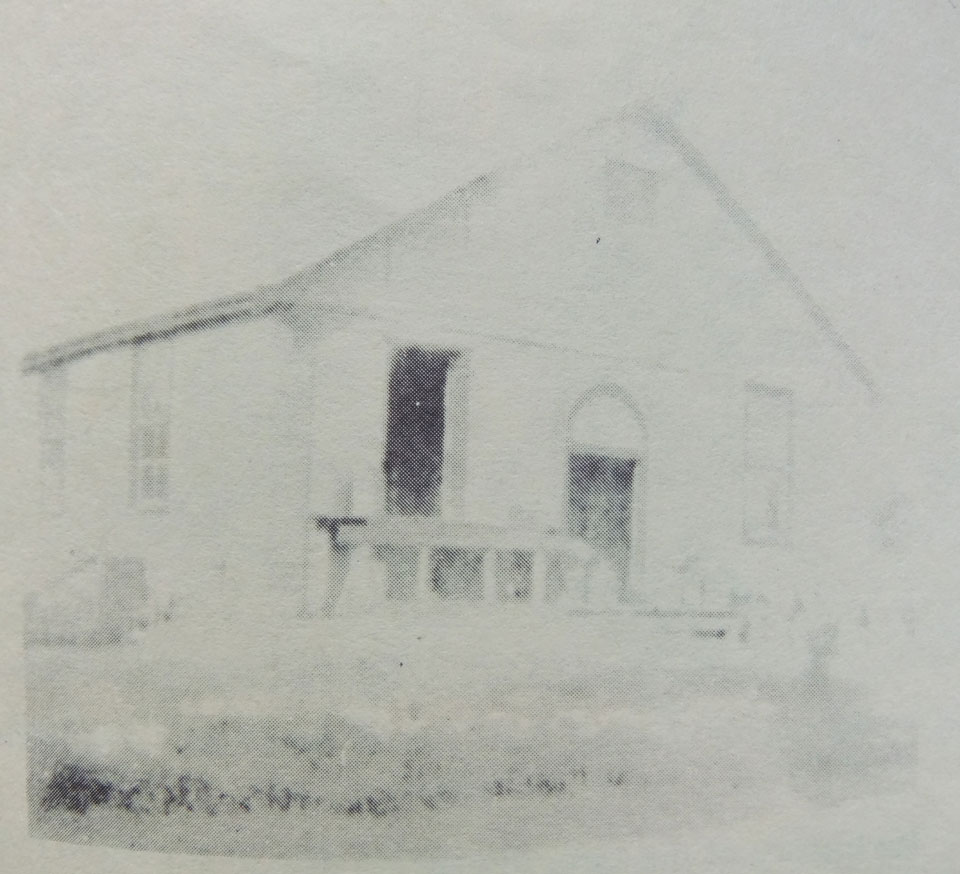
Original Factory building 1921
However, the depression of the 1930’s meant that things became tough and at one stage only 13 farmers were supplying milk to the factory.
Outside help and finance was needed and the Larcher family, who were city milk processors and retail suppliers in Fitzroy, bought 51% of the shares to take control and the remaining 49% of the Cooperative remained in local hands.
The injection of finance was just what was needed, farmers could be offered more for their milk and Larchers had a guaranteed supply of milk for their Melbourne customers.
This relationship lasted for 40 years and was to the benefit of all concerned as both businesses grew rapidly and were extremely successful.
The out break of war in 1939 changed things again, not just the markets overseas for the sale of produce, it also meant a significant change in the work force. The food industry was declared a protected industry. This meant that there was a restriction on how many men could leave to enlist, many did leave to fight in New Guinea and Europe, whilst those who had to stay were given time off to join and train in a militia that was held back in case Australia was invaded and they continued working at the factory. At the end of the war every man who had enlisted and wanted their job back were immediately reemployed.
The growth of the Cooperative continued as the immediate post war expansion of population meant a significant boost in milk and dairy production.
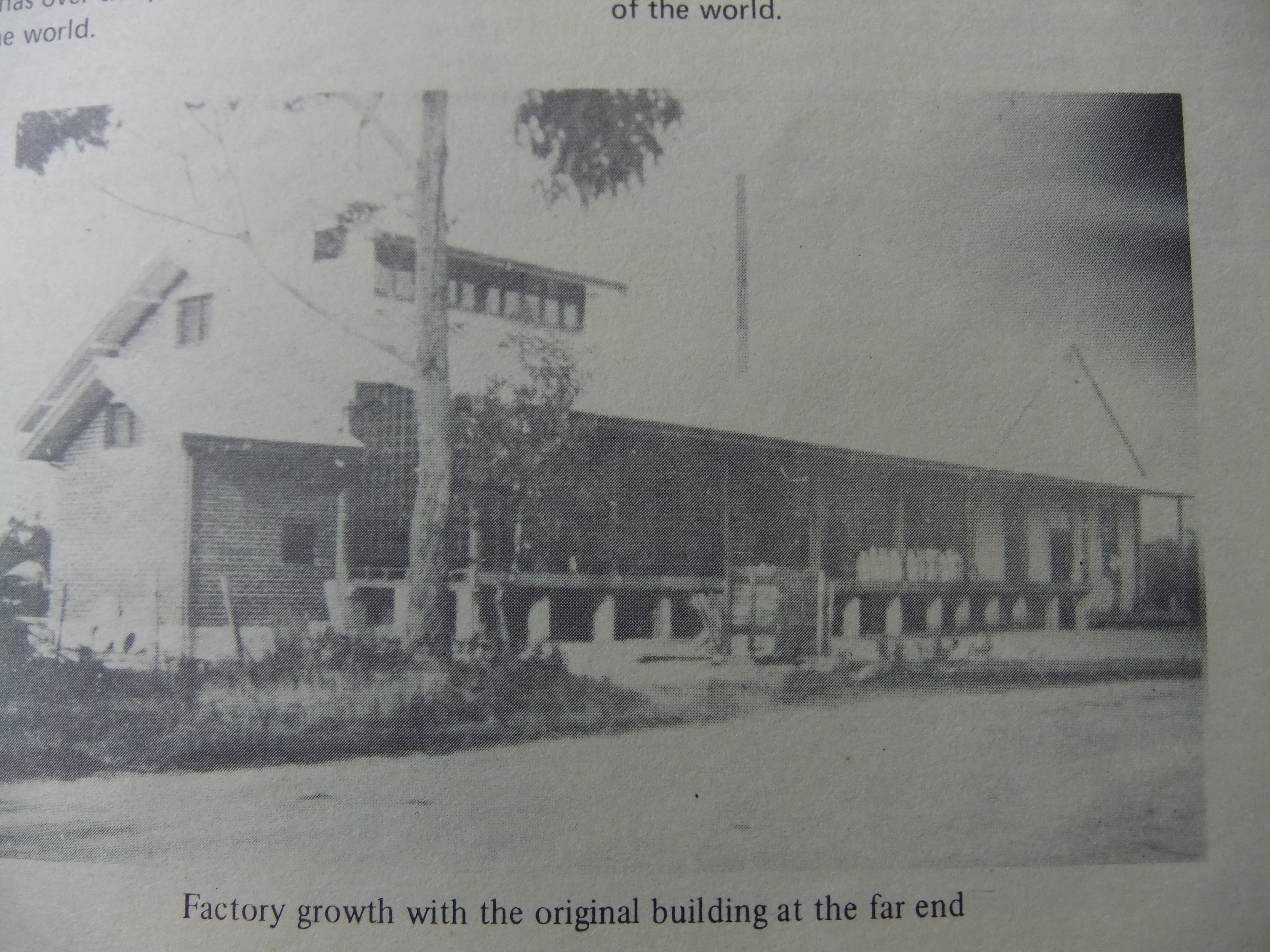
Factory 1930s
By the mid 1950’s nearly 50% of Melbourne’s liquid milk came from West Gippsland and Longwarry, Drouin and Warragul factories provided the major volume of this milk.
By the end of the 1960’s the dairy industry was to undergo dramatic changes again as the days of the milk truck travelling the district collecting cans of milk at the farmer’s gate were replaced by refrigeration and the cost-effective bulk handling.
This required massive investment money that the Larcher family, now lead by Ms. Pat Dauber, could not afford, so the factory was put up for sale.
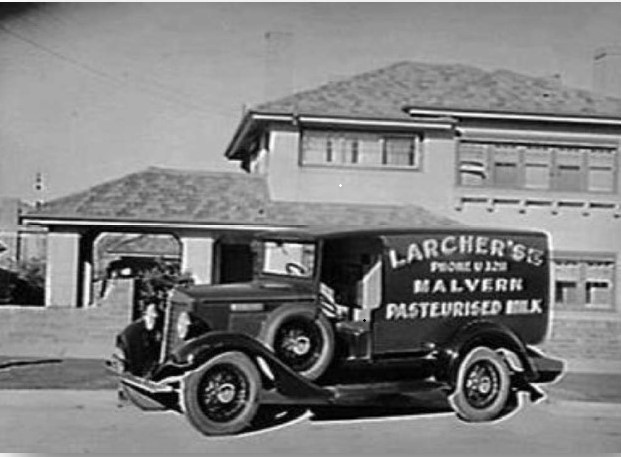
Larchers Delivery Van
The sale was necessary, the large investment to keep the factory productive and competitive was taken up by an English firm in 1972 and Longwarry became one of the Unigate Australia Factory’s.
Locals saw the results of this very soon after the sale when two large milk receiving silos capable of holding 50,000 gallons of milk and unloading 4 refrigerated milk tankers at a time appeared on the skyline over the factory.
Over these years the factory won many awards for its produce including in 1976 and 1977 they were awarded the best Full Cream Powdered Milk in the land.
In addition, international acclaim came their way with butter winning every major overseas dairy award.
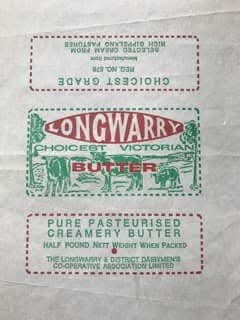
Award winning butter wrapper
In the days of being a cooperative with much of the factory owned by locals, it was more than just a work place, it was part of the town.
Apart from providing employment for many in Longwarry, the factory and its management have been acknowledged as playing a key role in the town and the district over time, with fund raising for local health facilities such as the West Gippsland Hospital and provision of labour and materials for community structures such as the Longwarry hall. Support for the local school and town organisations that required equipment or a few hands for a working bee were all part of the contribution.
When a fire emergency occurred men, not required for the safe maintenance of machinery, were released to fight fires. On many occasions the large milk tankers were loaded with water and taken out to the fire grounds to refill tankers. Local sportsmen were allowed to work short shifts or split shifts to represent the town in sport.
To be fair, subsequent owners also made contributions to life in Longwarry, but as it was no longer a cooperative, owned by locals it was never quite the same.
Whilst the connection to the town is now historical, our thoughts are with the men and women who have had custodianship of the legacy of 1921 will now be out of work. We hope that history will show that they are treated with respect by the employer as they leave their jobs and that they are able to commence a new stage in their working life.
It is now more important than ever that the history of this huge part of life in Longwarry is preserved, if you have any photos, stories or memorabilia please contact the Longwarry and District History Group at longwarryanddistricthistory@gmail.com.au
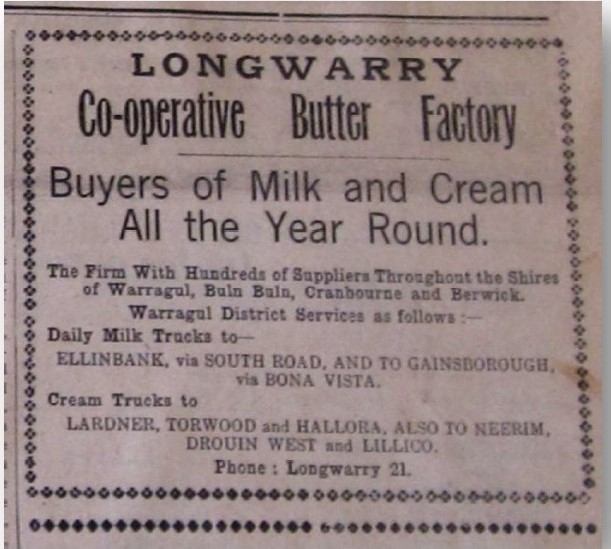
Factory Ad 1930s
We acknowledge the work of Graeme Butler for some of the detail provided
Excellent short history of the one time largest employer in town, possibly district.