Longwarry hasn’t always been a dairy town. In fact, up until the completion of the Gippsland rail line to Sale in April 1879, dairying hardly existed but became popular in 1881 when the land around the newly opened rail line was deemed suitable for dairy cattle. The subsequent tree felling was to use the land for dairies, but it also served as the beginning of sawmilling in the district. A local sawmiller, Mr Donald Fraser lobbied Victorian Railways to install a siding on the north side of the rail line, serving the Longwarry Run house on Musk Creek. The name Longwarry was attached to the siding and later became what we now know as Longwarry Station. The town which grew from the sawmilling took the name.
The 1880’s was a period of incredible growth in Melbourne. The need for stone and wood saw Gippsland viewed as a reliable source of much needed timber for construction, but mostly as firewood. The soon-to-be dairy farmers saw this as a way to get their land cleared, while the sawmillers saw it as a way to provide jobs and make profits.
The rail opened new opportunities for sawmillers to get their product to the hungry Melbourne market. Much of the timber in Gippsland was close to the new rail corridor and so transport of the logs to the rail head was considered quite easy for that time. However, as the timber was felled, distances to the rail increased and transport was becoming quite laborious, and expensive. With existing roads being no more than muddy tracks which were unpassable in Winter, an “all weather” method was required. Tramways were presented as a viable alternative for transportation.
Built from local hardwood with sleepers being 6 feet long, and 7 inches high and wide, with rails of sawn hardwood 6 inches by 3 inches and 6 inches by 4 inches, which were to be keyed onto the sleepers at intervals of 3 feet. These tramways would be the backbone of some sawmills in the region for many years to come, as well as providing a “lifeline” for those people that resided in the bush.
Most tramways of the time were simply a means of getting the timber out of the forest to the rail head. Millers found that moving the mill to another location was more economic, and easier than extending the tramway, so many lines were simply abandoned.
One tramway was an exception.
The Northern Tramway
Many entrepreneurial men decided to take advantage of the forests around Longwarry. This is a small sample of some of the main players, over the years.
1881 Donald Fraser
Donald Frasers’ first mill was situated approximately 250 metres to the north of the rail line. This first tramway was initially built in 1881 to service Frasers Mill, roughly running along what is now known as Drouin Road. It ran past a bark hut, which was to become Longwarrys’ first school, and timber was loaded onto trains to be shipped to Melbourne.
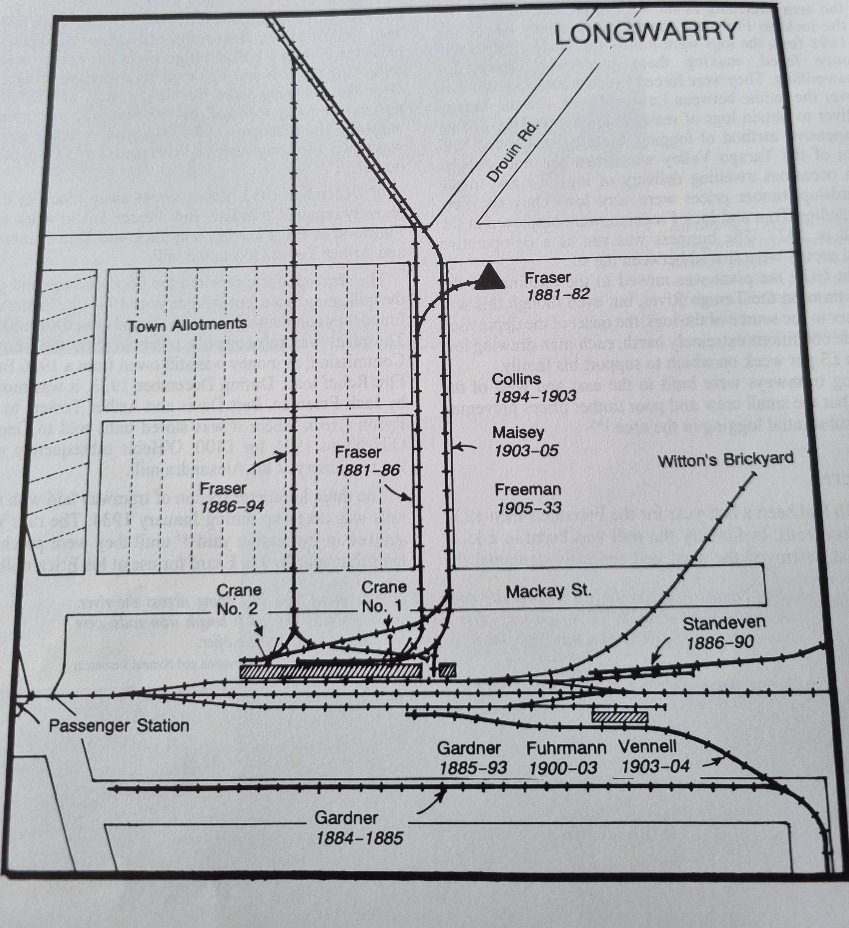
Early map showing first mills close to town. Current station position is lower left.
Map courtesy Mike McCarthy
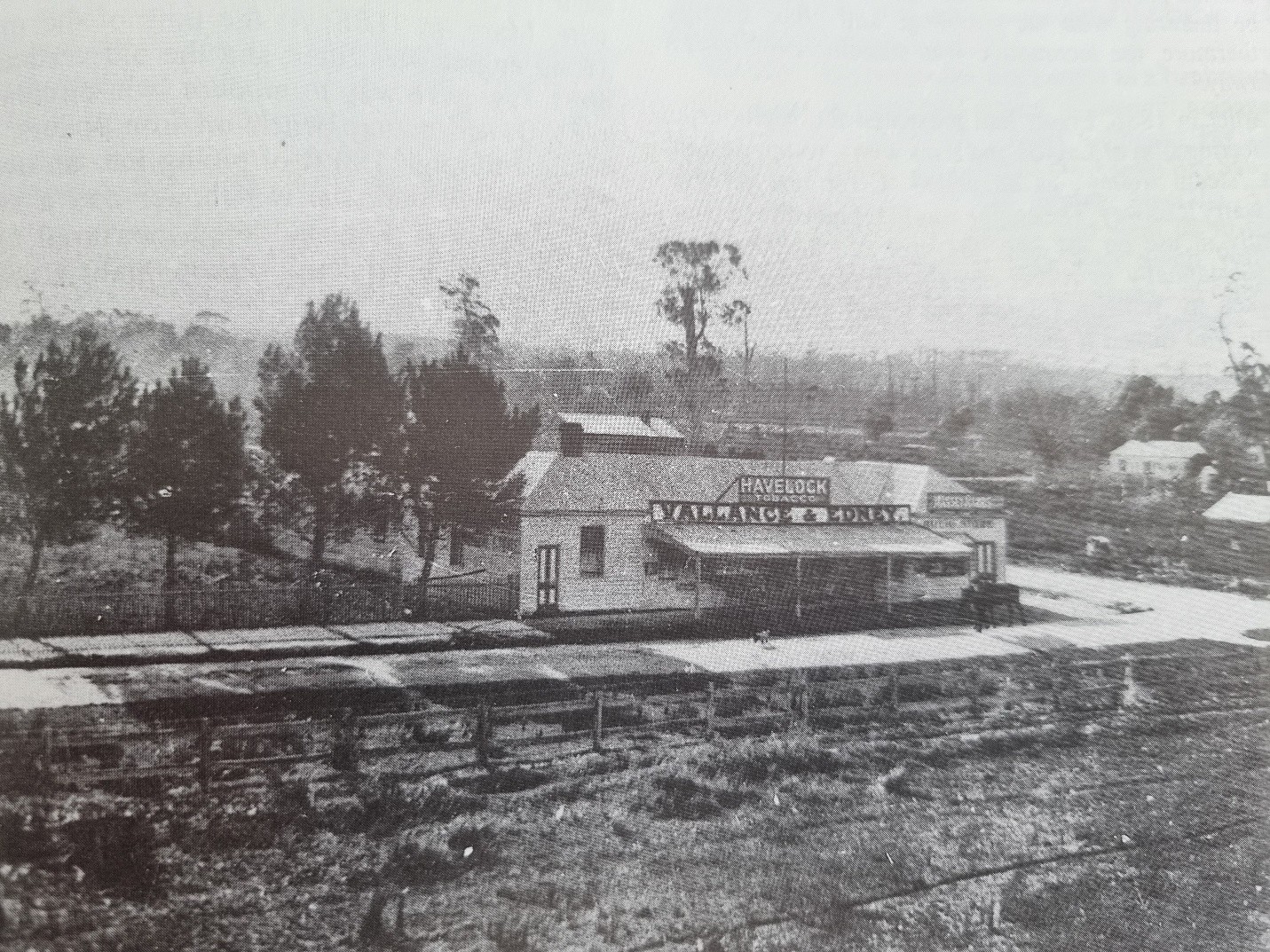
Vallance store in Longwarry, approximately where the pizza shop stands today. Freemans initial tramway passed to the right of the shop.
Photo C McDermid Collection
1882 The Trinca Brothers
Over time the north tramway would branch out to cover much more than originally planned. Late in 1881
the Trinca Brothers from Warragul selected land in the Jindivick Parish and established a mill approximately 14 klm north-east of Longwarry. The Trinka’s wanted to extend the existing tramway, but cost was a problem. The solution was suggested by Fraser himself. Fraser wanted to move his mill further north into the forest. So, the plan was that Fraser would build the first 4klm to the Tarago River, with the Trinka’s financing the rest of the line to their mill. The Tricas agreed, and the line was built.
In 1882 the Trincas employed Melbourne man William Henry (Harry) Collins as their tram driver at their Labertouche mill. Collins was to become a major player in the milling industry in years to come.
1883 Edward Edwards
In 1883 Edward Edwards and a consortium established a mill approx. 3 klm north of Longwarry. A spurline had been built off Frasers’ original line close to the crib work bridge over the swamp on Sand Road, and the mill was built adjacent to it using it to transport logs to the rail. This mill was short lived and closed in 1885.
Donald Fraser then formed the Longwarry Sawmilling Company in 1883, primarily to purchase the mill and land of the Trinca’s. Along with some partners Fraser then proceeded to erect a second mill approximately 1 klm west of the Trinca’s original mill. A spur line was built off the original line about 1.5 klm south of Labertouch Creek.
1886 Locomotion in the Forest
1886 saw the first use of Locos to pull the logs out of the bush to the rail. Fraser had engaged a Melbourne firm to design and build what he called a “steam trolley” that could move 30 tons at 8 mph over wooden rails. This was an important step, as the cost of chaff for the horses had risen substantially in recent months. On 9th June 1886, the first trial run on the loco with a full load took place and was immediately successful. The loco replaced horses from that time onward.
The loco could clear the output from the Labertouche Creek mill in the morning, and the Gipsy Creek mill in the afternoon, a task that would have taken many trips using horses.
1887 William Henry (Harry) Collins
Harry Collins purchased the Gipsy Creek mill from Mary Fraser, and Alexander Mackay, and moved it to the Robinson Creek site, 14 klm North of Longwarry. A tramway was to be built to service the mill and was begun in 1889. However, Daylesford sawmiller Thomas Orde had holdings 10 klm north of Longwarry in the path of the planned tramway and refused access to Collins to lay his line until correct easement permits had been granted. Collins was forced to transport his goods via road until 1891 when the easement had been granted.
Ironically Orde abandoned his milling licence soon after.
Collins Robinsons Creek mill was serviced by a tram into Longwarry in the morning, returning at 2pm in the afternoon. The tram also ferried mill workers and their families into town on Saturdays, returning on Sunday with the passengers slightly worse for wear after a night out, but ready for a 7am start the next day. A school was established at the Robinsons Creek mill in 1891 with 17 students in attendance. It shared a teacher with the Labertouche school some 7klm away and opened on alternate days. The Labertouche school closed in 1894, and the equipment and some of the pupils (and teacher) moved to Robinsons Creek. Although the school remained at Robinsons Creek, the mill was moved in 1891 to a spot on Ryson Creek about 3 klm north. When tin was discovered on the Ryson, Collins had the mill moved closer to the likely site for a settlement to service the mine. We now know no mining settlement eventuated, and the initial rush of prospectors quickly waned, however some mining did continue until 1926.
The new line servicing Ryson Creek mill was completed in 1892. It branched from the Robinsons Creek line at Robinsons Hill and down the valley to the mill. Collins had a substantial home on the old mill site, so the old tramway was kept “in repair” for the family to travel to Longwarry as well as the new mill site. This line was abandoned in about 1900 when Collins built a new home 3 klm closer to Longwarry and extended the existing tramway to his new house to allow easy access to Longwarry.
A further change to the tramway occurred a few years later. Collins had been negotiating with the Railways Department for the lease of steel rails for his tramway. The high rental cost kept Collins from going ahead, until in 1896 the Railways halved the rental cost, and Collins went ahead. The new steel line followed the path of the existing timber line out of Longwarry, until a point approximately 1klm North of the town where it veered east to follow the path of a recently opened road connecting Longwarry to Sand Road. The new line passed through Collins property and joined the old timber line quite close to Frasers original line near Kydds Gate. This new line had advantages over other lines, as it used a public road for half the distance (hence no royalties to other millers) and was substantially shorter, lessening the time to transport logs to the railhead. This new “direct tramway” opened on 3 June 1896 to much fanfare in the town.
The years 1896 and 1897 were prosperous for Collins. The annual contract for railways sleepers and the need for timber for the Melbourne sewage works kept the mills running. The gold mines in the Ballarat area also need “poppet” logs. These logs measured approximately 9 metres plus, but in November 1897 a set of logs measuring 30 metres was dispatched using the tramway to the rail. The Ryson Creek mill closed in 1901 and was moved to Tea Tree Creek 1.5 klm away. A new tramway line was built to the mill. In 1906 the mill was put up for auction at Kennedys Hotel Longwarry. Collins had been suffering from ill health for some time, and the .low timber prices since Federation were factors in hos decision to sell. Collins has installed a “dummy bidder” in the crowd to drive up the price. Tom Maisey showed a little too much enthusiasm while bidding, and at the end found himself in the sawmilling business, as well as his local shop. Collins died on 6th December 1906.
A successful and somewhat colourful identity in the milling history.
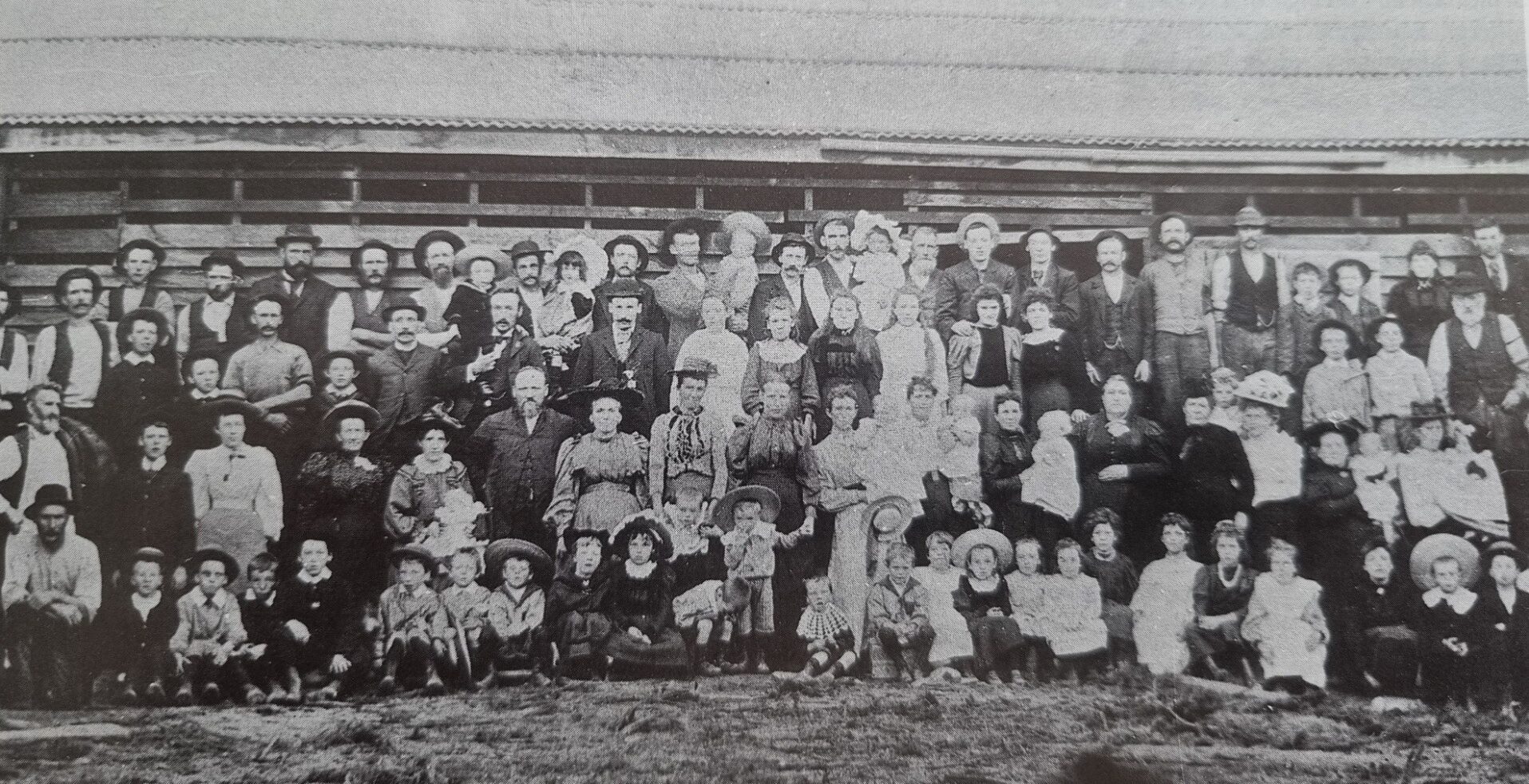
Residents of the Ryson’s Creek mill around the turn of the century. W.H. Collins and his wife are centre of the front row. Photo courtesy C McDermid Collection
1888 – 1889 Donald Fraser
In 1888 Fraser was having trouble with the use of his locomotive on the town streets, the dangers of which were emphasized 2 years prior, when a young boy was injured when he was thrown from his mount and struck by the tram truck wheels being drawn by horses. If this could occur with horses, then imagine what may happen with a locomotive, with its unsettling effect on horses. Frasers’ answer to this was to purchase a town allotment, and run the tram track through his own property, and into the station yard.
During this time, Fraser moved the Labertouche mill to a site closer to the timber and extended the tramway to suit. He also fitted a new 16hp to a new modern twin circular saw, with a 74ft self-acting bench on iron rollers, the first of its kind in Victoria.
Sadly, soon after the mill had been moved, Fraser was admitted to a Melbourne hospital where he died on 26 August 1888, leaving his Wife Mary as sole owner of the mill.
A school was established at the Labertouche Creek mill in 1889. Previously children had attended Labertouche school some 8 klm away, which, while a long distance, was made even more difficult over the muddy, wet tracks in Winter. The school doubled as a hall, and dances and parties were held there, ironically attended by some Longwarry townsfolk, who were transported to the hall via the tramway.
Mary Fraser died in November 1889, and the mill passed on to her Son–in–Law Alexander Mackay. Mackay worked the mill for 4 more years, but the downturn in orders saw it run at a reduced rate.
In 1893 The Estate of Mary Fraser, and Alexander Mackay were declared bankrupt. The mill continued operating until February 1894, when it was finally closed and all assets associated were sold off, and all structures removed. The only asset that wasn’t sold was the tramway, and in fact a tramway repairer was employed to maintain the first 4 klm of track out of Longwarry, as Harry Collins was using this section of track and a royalty was being paid for this use. This ceased in 1894 when Collins built his own line into Longwarry.
Alexander Mackay was eventually discharged as a bankrupt, and went on to become Manager of many sawmills, both in Victoria, and later in Coffs Harbour NSW. From there he went on to be a Director of forests in NSW and Queensland, and until 1919 was engaged in establishing sawmills in Borneo, Russia and New Caledonia. He died in 1941.
Many mills were opened and subsequently closed in the ensuing years. Most lines were simply built and left when the timber had been recovered. The lines pushed further North into the forest, eventually winding up at The Blue Range, which was deemed too difficult for a tramline to be built across it.
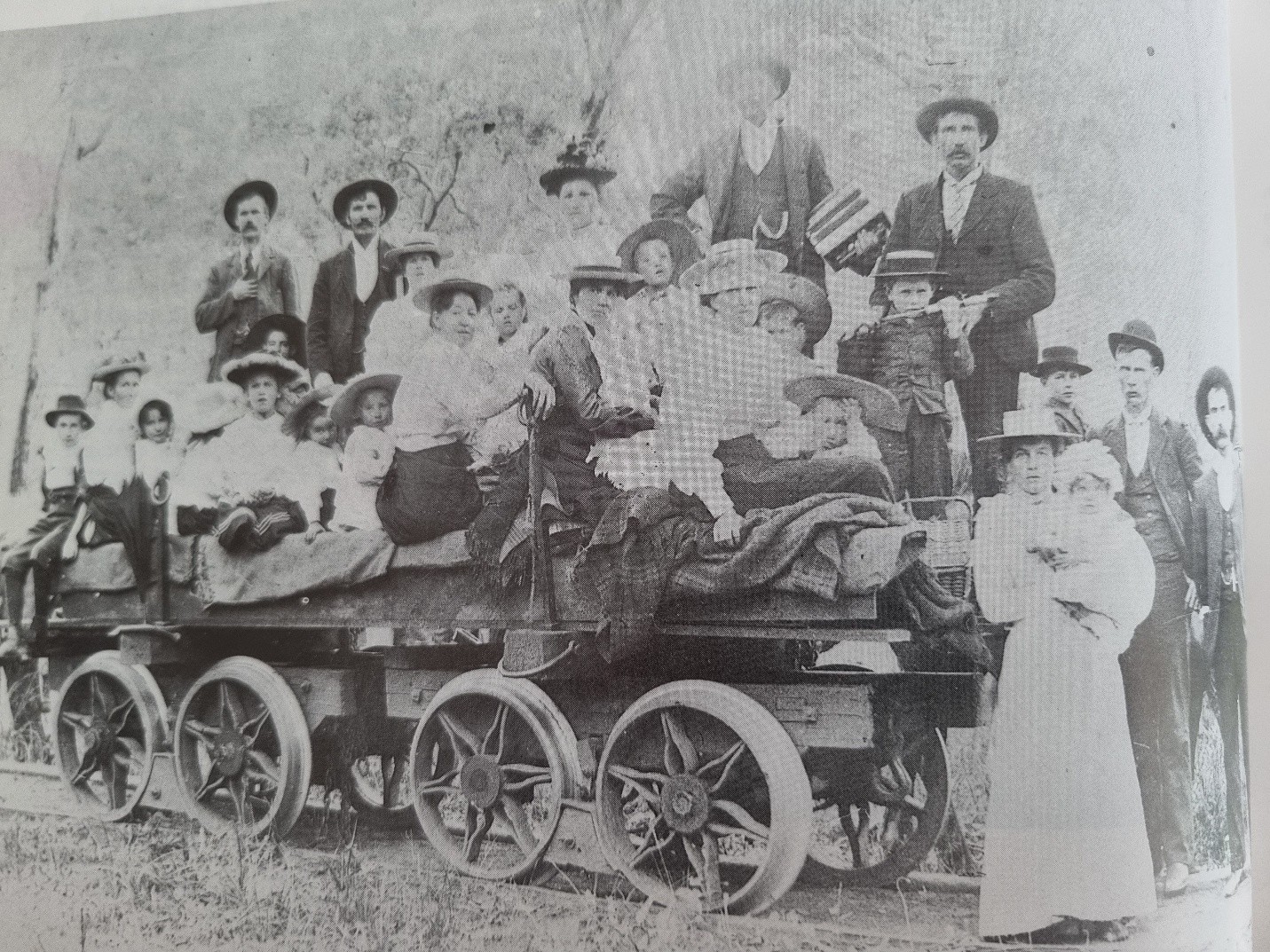
Spurlines had been built off the main line to service mills and the people who lived in the forest. These people would often travel to town via the tram and became quite a social occasion. The gentleman in the back row took his “squeezebox” for entertainment on the trip to town.
Photo courtesy C McDermid Collection
1903 Tom Maisey
When Tom Maisey purchased the mill from Collins, he was also running a successful store in Longwarry which required his presence. He installed a mill boss (Mr R C Mackay) and made his son Bill Maisey overall Manager of the business. In October 1903 work commenced on a new tramway to end a short distance north of Tea Tree Creek, where the mill was to be re-sited to over Christmas. During the time the mill was shut down for the move, the Railways Department saw the lack of activity on the No 2 Crane at the station as a reason to remove the No 2 crane. The crane had “apparently” been idle for many years and so it had to go. This left Maisey with an expensive re-route of his tramway to the No 1 crane.
Maisey built houses for the married millers around the mill, and back-loaded supplies from his grocery store for provisions for the workers and their families. However, even though this should have been a profitable venture, the mill was put in the hands of receivers in 1905.
1905 John Freeman
Freeman purchased Maisey’s mill in June 1905. John Freeman was a successful sawmiller from Western Victoria, and invested heavily in tramway infrastructure and mill upgrades upon his arrival. He reconstructed many of the bridges along the tramway into Longwarry, and built a new chaff shed at the station in 1907. However the large amount of timber coming out of the upgraded mill was testing the platform facilities at the station, this along with the return of the Collins Brothers to the Labertouche forest meant the return of No 2 crane should be looked at, and with the Railways Commissioners to visit in April 1908, Freeman was going to make sure his grievances were heard. Mr Thomas Tait headed the dignitaries and shut down any talk of the No 2 crane returning, Indeed his blast was so severe the West Gippsland Gazette reported that “None of us regretted the departure of this amiable Gentleman.” In 1909 Freeman had the tramway extended to a site at the junction of the Bunyip River and Tin Creek about 22 klm north of Longwarry. This site was chosen, as it offered ample timber along the Bunyip River and Tin Creek, which would last longer than the usual 5 or 6 years of a mill’s life. This however brought new challenges for Freeman as the logs had to be trucked further to the rail head. Freeman’s solution was quite simple, he broke the journey into 2 sections, with a different horse team and driver working each section. A change point was set up which was to become known as “The Slips”, where 2 deliveries of logs were brought down from the mill individually each day, and these 2 loads were combined for the trip into Longwarry. The mill setup by Freeman on the Bunyip River remained at the Tin Creek junction for 16 years. A life span longer than any other mill in the district. John Freeman retired in 1916 and left the mill to his 3 sons.
1916 Proctor and Pearce
Bill Proctor and his son in law, Dick Pearce established a small “spot” mill about 11 klm north of Longwarry, fronting the Bunyip River. Their plan was to use Freeman’s existing tramway to transport the logs to the rail. Initially the logs were hauled by bullock to Longwarry, but after 12 months Freeman agreed to them using his tramway (at a cost) from “The Points” siding which had been used earlier by Collins. Proctor and Pearce purchased a single tramway truck from Freeman and used this to make daily trips to Longwarry.
Late in1920 a new location for a mill was required by Proctor and Pearce. A selection about 1 klm west of Freemans tramway was identified, and all equipment from the existing mill was moved to the new site. An old Marshall boiler was abandoned at the site, but the stationary engine it powered was sold to the Longwarry Milk Factory. A branch line from Freeman’s tramway was built to the new site, and logging began. Pearce later sold his share of the mill to the Proctors about 1922 and in 1923 joined with Mr Inger to establish a mill on the Ryson Creek, not far from the burgeoning tin mines.
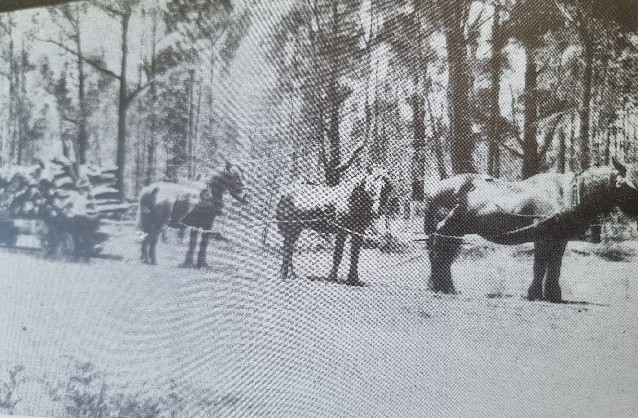
Firewood Tram circa 1918. Note the tram on the tracks.
Photo courtesy C McDermid Collection
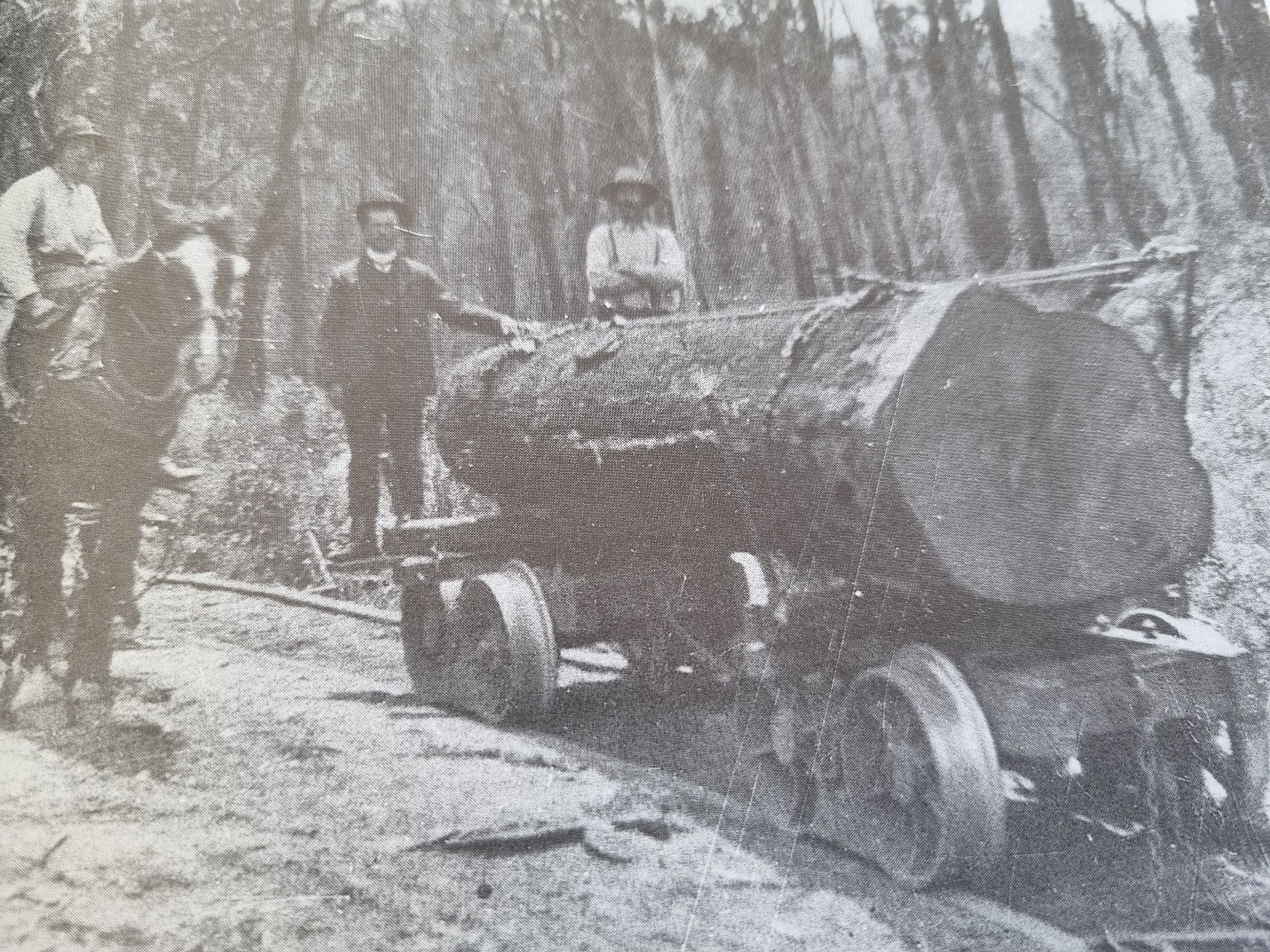
A load ready for dispatch to Freemans Mill, circa 1920. Would likely have been pulled by the new steam engine.
Photo courtesy C McDermid collection
1922 Alex Kerr / Harry Nash / Jack Ure
A fellow with little knowledge of sawmilling then expressed a desire to purchase the mill of the Proctors in 1922. Alex Kerr had no experience in sawmilling but took over the Proctors mill on 1 April 1923. Kerr applied additional acreage on the Blue Range, and when approved began building a mill to cut the timber. Another branch line of the Northern tramway was built to connect with Proctors old line, which then connected with Freeman’s line for the trip to town. Kerrs biggest mistake was closing down the old mill while the new mill was being built and fitted out. With no income from the old mill, Kerr was declared bankrupt in May 1924, and oddly enough Proctor began an arrangement with Ern Smedley to take over Kerrs debts and run the mill with the assistance of manager Norm Sutherland. This “partnership only lasted 12 months before Smedley died suddenly in November 1924.Sutherland had built a line from the mill to connect with another new sawmiller Harry Nash’s’ line. By this time the mill had been leased to Jack Ure, and he proceeded to run the mill with an iron fist. Ure’s first decision was to cut the men’s wages, a decision which led to a strike and ultimately the sacking of the entire workforce. A new workforce was employed, but 3 months later the mill was silent again, Ure had gone broke and the mill never reopened.
1926 Bush Fires
The 1926 bush fires destroyed much of the tramway. Although efforts were made to rebuild the lines, the follow up fires in February 1932 again burnt the tramways and bridges. The lines were built yet again, only for the horrendous flooding of December of that same year to wash away all the rebuilt lines. Many millers left at that time, and sections of the tramway were left to decay in the bush, as were the numerous mills, which were to become targets for scrap merchants in years to come. Some of the motors which survived the fires were moved to different mills, but the mills themselves were left in the bush.
1935 The end is near.
Many other smaller millers used the tramway at some point. Many lasted no more than 12 months before timber prices or acts of nature saw them leave the bush and never go back. By 1935 only a very small number of mills operated and used the tramway. Indeed even Freeman with his vast knowledge and resources had closed his final mill in 1933.
It’s estimated that over 100 klm of tramways were built into the forest North of Longwarry. Little is left of them since the closure around 1935. Fleeting glimpses have been uncovered over the years, only to be torn up and destroyed. Many tramways were destroyed either by the bushfires of 1926, or the devastating floods of 1934. Some tramways were constructed using steel rails which were leased from the Railways Department. These were abandoned and the rails left at the side of the heavy rail corridor, where in time they were taken away and scrapped.
The Northen tramway was an important part of the history of sawmilling in the district. From humble beginnings as a tramway to serve Fraser’s mill, 250 metres from the rail line, it became the main system serving many mills to the north of Longwarry. When it closed in 1933 the northern tramway had been in operation for 51 years and had carried an estimated 486,000 tons of timber to the rail. This incredible lifespan was surpassed by very few, if any in Victoria and indeed Australia, and should be remembered as being pivotal in the establishment of Longwarry as a timber town.
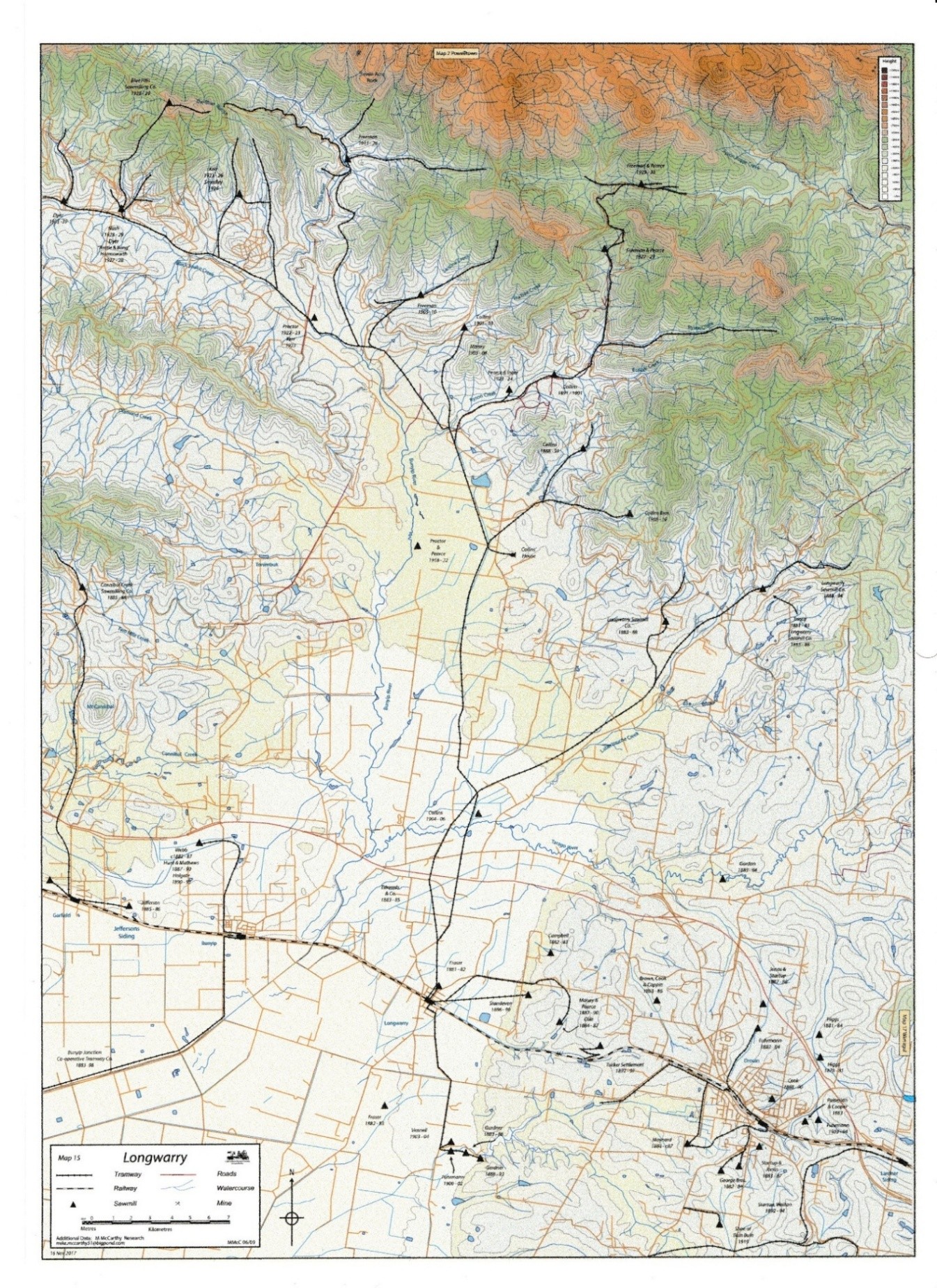
Map of Longwarry Tramways courtesy of Mike McCarthy
Timeline of The Main Northern Tramways with Millers noted.
1881 – Fraser – Line laid to Mill 250 metres north of railway line.
1881 – Trinca Bros – 14klm northeast of Collins house.
1883 – Longwarry Sawmilling Co. Spur line north of Labertouche Creek
1888 – Longwarry Sawmilling Co. – extension of line from Trinca Bros northeast
1888 – Collins – Branch line to Collins mill, later to be used by Inger.
1891 – Collins – Branch line northeast to service Ryson Creek Mill
1901 – Collins – Line extended north to Tea Tree Creek Mill
1903 – Maisey – Used above Collins extension for Tea Tree Creek Mill
1904 – Collins – north of Tarago River
1904 – Maisey Branch line off main line northeast to Sardine Creek Mill
1905 – Freeman – used above Maisey line for Sardine Creek Mill
1908 – Collins – Spur line east just north of Collins home.
1911 – Freeman & Pearce – Branch Line across Black Snake Creek north to Bunyip River, then west into the forest to service Black Snake Creek Mill.
Another spur line east to Tin Creek Forest
1922 – Proctor – using “Main” Black Snake Creek line
1923 – Freeman & Pearce – using Ryson Creek branch line
1923 – Kerr – using “Main” Black Snake Creek line. Also spur line off “main” line north of Black Snake Creek.
1923 – Pearce & Inger – Using Ryson Creek branch line
1925 – Nash – “Main” Line extended northwest of Black Snake Creek
1926 – Smedley – using spur line off “main” line north Black Snake Creek.
1927 – Freeman & Pearce – Extension of branch line from Collins mill, north along Lawson Creek to Gentle Annie.
1927 – Hemsworth – line extended further northwest towards Gembrook
1928 – Blue Hills Sawmilling – End of the “Main” line finishing at The Blur Range, and the end of the northern line.
1929 – Freeman & Pearce – spur lines northeast to mill located south of Spion Kopje Creek, with smaller lines leading into the forest. This was the final extension east.
Acknowledgements:
Much of the information contained is from “Settlers and Sawmillers” a book by Mike McCarthy. We are extremely grateful for Mikes’ permission.
Other references The West Gippsland Express 1889
Comments